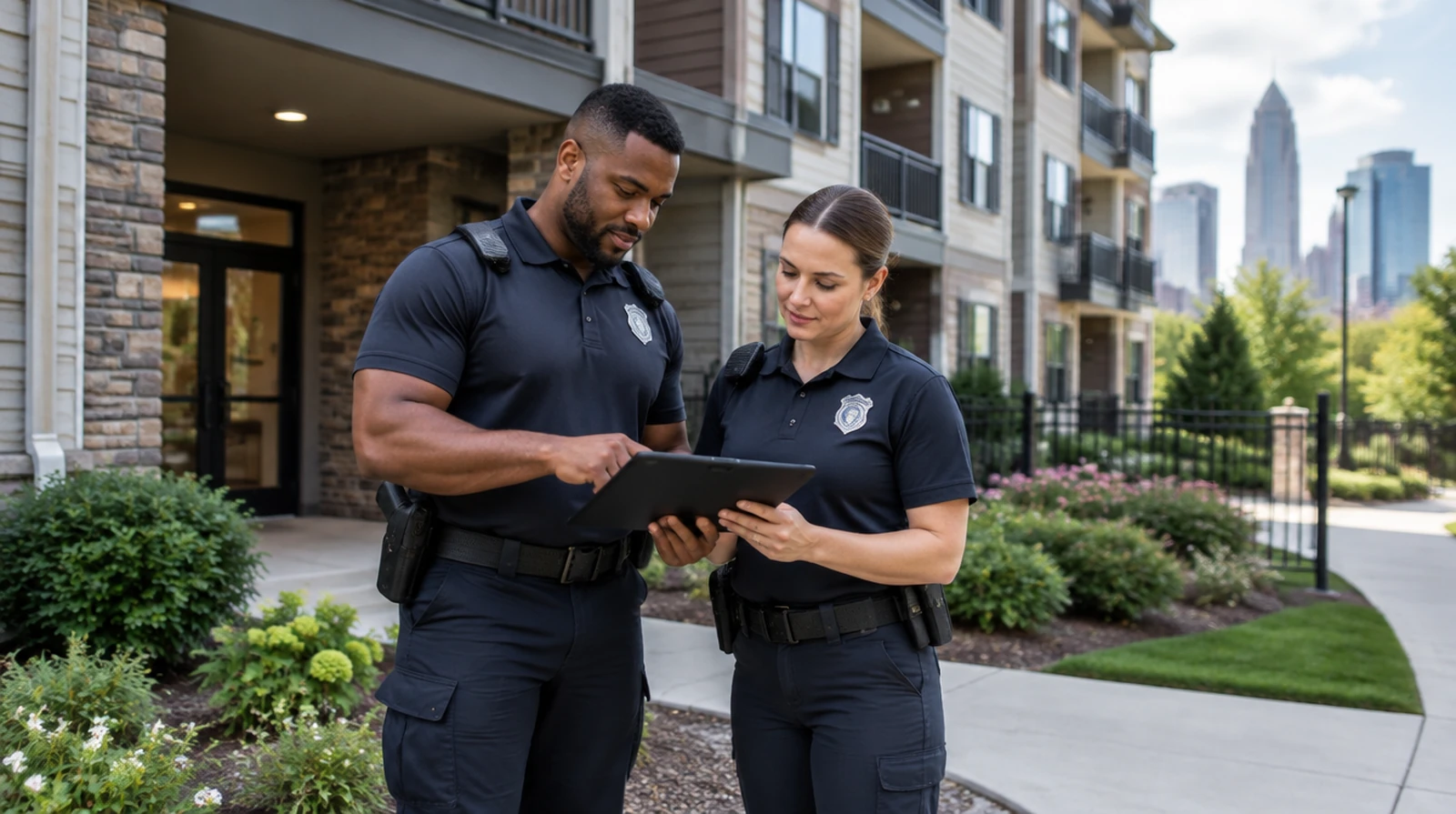
Armed vs Unarmed Public Safety Officers: A Site Assessment Guide for Multifamily and Commercial
Charlotte property managers and boards rarely need a philosophical debate about “armed vs unarmed.” They need a site-level answer: what risk is actually on the property, what presence residents and tenants will accept, and how coverage should look on a Tuesday at 1 a.m. versus a Friday amenity rush.
Public safety officers can work either model. The decision belongs in a Community Safety Assessment — not in a one-line RFP checkbox. Paladin Public Safety staffs both armed and unarmed public safety officers for multifamily, commercial, and related sites across the Charlotte metro.
Quick answer: Choose armed coverage when the site’s risk profile, asset value, or incident history calls for elevated deterrence and rapid response capability. Choose unarmed coverage when professional presence, de-escalation, access control, and welcoming property safety are the primary need. Many communities mix both — or layer either model with mobile patrol. Start with a free Community Safety Assessment or call (980) 446-3294.
Paladin Public Safety
8501 Tower Point Dr, Suite 204
Charlotte, NC 28212 · (980) 446-3294
Certified · Licensed · Trusted · 24/7 dispatch
When an armed post makes sense vs unarmed coverage
Neither option is automatically “better.” Match the posture to the property.
Unarmed public safety officers often fit when the priority is:
- Visible, professional presence at lobbies, amenities, and common areas
- De-escalation and customer-service-forward property safety
- Access control, visitor management, and package / common-area monitoring
- Multifamily communities, office buildings, retail centers, and HOAs that want a welcoming community safety tone
Armed public safety officers often fit when the priority is:
- Elevated deterrence for higher-risk environments
- Rapid response capability for critical incidents
- Financial institutions, luxury properties, high-value asset locations, or sites that ownership has already classified as needing a stronger posture
- Compliance-sensitive roles that require state-licensed armed credentials and ongoing qualification
Paladin’s armed officers are positioned for trained, licensed, visible deterrence in high-risk environments, with background checks, psychological evaluations, and ongoing firearms qualification as described on our armed public safety officers page. Unarmed officers are positioned for professional presence and patrol in environments that should feel safe and welcoming — see unarmed public safety officers.
If your board is still arguing from headlines instead of site facts, pause the vote and walk the property first.
What a Charlotte PM or ownership should put in the site assessment
A useful assessment is not a brochure walk. It is a risk and operations map your board can use.
Bring (or ask the vendor to capture):
- Incident and complaint history — after-hours noise, vehicle break-ins, amenity misuse, trespass, package theft
- Hours that matter — amenity close, lobby open, known weekend pressure, move-in windows
- Amenities and access points — pool, clubhouse, fitness, mail/package rooms, secondary cut-throughs
- Cash, keys, and high-value zones — leasing office cash handling, server closets, storage, loading docks
- Resident / tenant expectations — how “armed presence” will land with families vs corporate tenants
- Neighbor context — adjoining commercial, short-stay, or cut-through traffic that changes risk after dark
- Reporting needs — what ownership and the board actually read on Monday morning
Your free Community Safety Assessment should turn those inputs into a staffing approach — posted officers, mobile patrol, after-hours coverage, or a mix — without promising police powers.
How public safety officers run either model (without overpromising)
Public safety officers are property-focused professionals. They are not a substitute for law enforcement, and a calm B2B scope should say so.
In either armed or unarmed coverage, expect:
- Visible presence that changes behavior at lobbies, lots, and amenity hours
- Observe-and-report discipline matched to your escalation path
- Property-specific protocols (access, visitors, amenities, after-hours quiet)
- Digital shift and incident documentation your PM team can actually use
- 24/7 dispatch support when after-hours needs escalate
Armed coverage adds firearms credentialing and a posture designed for elevated deterrence — still professional and approachable for residents and visitors, not theatrical. Unarmed coverage emphasizes de-escalation, customer service, and systematic rounds. Both models live under the same public safety officers service language we use on every contract conversation.
Do not write a scope that implies arrest powers, pursuit, or “we replace CPD.” Write a scope that protects the property and documents what happened.
Mixing posted officers with mobile patrol
Many Charlotte multifamily and commercial sites do not need an all-or-nothing choice. They need the right layering.
| Site need | Often leans toward |
|---|---|
| Constant presence at a gate, lobby, or amenity desk | Posted public safety officers (armed or unarmed by risk) |
| Large footprint, multiple buildings, parking loops | Mobile patrol |
| After-hours exterior and amenity checks with readable reports | Mobile patrol + clear reporting cadence |
| Peak weekends, events, or known pressure windows | Temporary posted coverage layered with patrol |
| High-value or higher-risk zones inside a mostly welcoming campus | Armed post at the risk node; unarmed or patrol elsewhere |
How to scope mobile patrol — routes, dwell times, amenity checks, after-hours expectations — is covered in our mobile patrol scoping guide for Charlotte property managers. Use that post for patrol mechanics; use this one for the armed vs unarmed posture decision.
A Community Safety Assessment is where those two conversations meet on your site plan.
How to request a Community Safety Assessment / quote
- Call (980) 446-3294, or start from the quote / assessment path
- Share property type (multifamily, commercial, HOA, mixed-use), address, and whether you are comparing armed, unarmed, or a mix
- Note pressure points: amenities, after-hours, cash/access zones, recent incidents
- Schedule an on-site walk with your PM or board contact
- Review the customized community safety plan when it lands — then decide staffing
Hub CTA and service overview: paladinpublicsafety.com. Related reading: what a free Community Safety Assessment covers.
Soft next step
If your next board packet still says “add coverage” without saying armed, unarmed, posted, or patrol — walk the property with us first.
Free Community Safety Assessment · (980) 446-3294 · paladinpublicsafety.com
Paladin Public Safety — Certified · Licensed · Trusted. NC-oriented public safety officers for property managers and boards. Soft educational guidance only; final scope is in the service agreement.
Need Professional Public Safety Services?
Contact us today to discuss how Paladin Public Safety can protect your business with our professional public safety solutions.
More Articles
How Charlotte Property Managers Should Scope Mobile Patrol with Public Safety Officers
How Charlotte property managers should scope mobile patrol with public safety officers — routes, dwell times, amenity checks, reporting, and a free Community Safety Assessment.
What a Free Community Safety Assessment Covers for Charlotte Multifamily Property Managers
What Paladin Public Safety’s free Community Safety Assessment covers for Charlotte multifamily property managers — site walk, staffing plan, and next steps. Call (980) 446-3294.