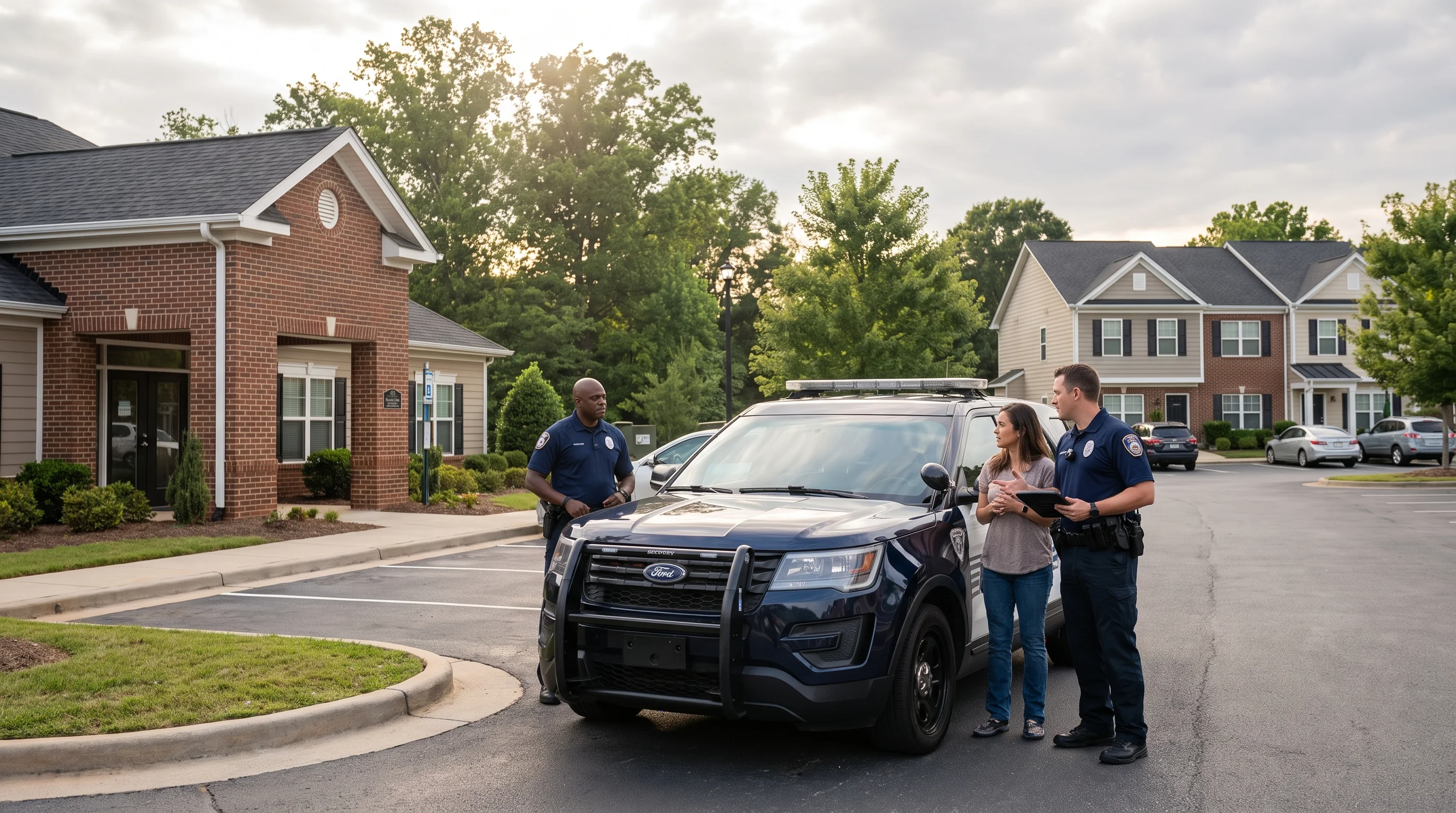
How Charlotte Property Managers Should Scope Mobile Patrol with Public Safety Officers
Charlotte property managers rarely need “more coverage” in the abstract. They need a patrol plan that matches the site: which lots get checked, how long an officer stays at the clubhouse, what happens after amenity hours, and how the board will read the report on Monday.
Mobile patrol with public safety officers is one of the clearest ways to cover a larger footprint without posting someone at every door. Done well, it is scoped like any other operational service — routes, dwell times, checklists, and escalation — not a vague promise that someone will “drive by.”
Quick answer: Scope mobile patrol the way you would scope any community safety vendor: define routes and priority stops, set dwell times and amenity checks, name after-hours expectations, and require reporting your board can use. Paladin Public Safety staffs public safety officers for mobile patrol across Charlotte multifamily and related properties. Start with a free Community Safety Assessment or call (980) 446-3294.
Paladin Public Safety
8501 Tower Point Dr, Suite 204
Charlotte, NC 28212 · (980) 446-3294
Certified · Licensed · Trusted · 24/7 dispatch is live
When mobile patrol fits vs posted public safety officers
Neither option is automatically better. The right mix depends on layout, complaint history, and what “visible presence” means for your residents and ownership group.
| Need | Often leans toward |
|---|---|
| Constant presence at a gate, lobby, or amenity desk | Posted public safety officers |
| Large site, multiple buildings, parking loops, or satellite lots | Mobile patrol |
| After-hours amenity and exterior checks with a readable report | Mobile patrol + clear reporting cadence |
| Peak weekends, move-ins, or known pressure windows | Temporary posted coverage layered with patrol |
| Several sister properties under one regional manager | Shared mobile patrol plan with site-specific stops |
Use posted officers where presence has to be continuous. Use mobile patrol where coverage needs to move — and write the scope so “move” does not mean “rush through.” Industry context for multifamily and related sites lives on our industries page; officer roles are outlined under public safety officers.
What a Charlotte PM should put in the mobile patrol scope
A weak scope says “patrol the property.” A usable scope tells the vendor — and your board — what success looks like on a Tuesday at 1 a.m.
Routes and priority stops
List the path a public safety officer should actually take. Typical Charlotte multifamily stops include:
- Primary and secondary vehicle entries / cut-throughs
- Parking decks, overflow lots, and dumpster / service courts
- Blind corners and poorly lit walkways you already know about
- Mail / package areas and breezeways residents use after dark
- Any shared wall with commercial or short-stay neighbors
If two buildings share a driveway but only one generates complaints, say so. Priority stops should follow risk and resident friction — not a perfect circle on a map.
Dwell times (not just drive-bys)
Dwell time is where mobile patrol becomes property safety instead of a drive-through. For each priority stop, note whether the officer should:
- Slow-roll and observe
- Park and walk a defined loop (for example, clubhouse perimeter + pool gate)
- Spend a minimum number of minutes at high-friction spots
You do not need theatrical dwell times. You need enough time that an officer can notice an unlocked amenity door, an open vehicle, or a gathering that does not belong after hours — and document it.
Amenity checks
Put amenity checks in writing. Common items for Charlotte communities:
- Pool / spa gates and furniture left outside the fence line
- Clubhouse / leasing suite exterior after closing
- Fitness room doors and after-hours access behavior
- Package rooms and mail kiosks
- Dog parks, playgrounds, and fire pits when those spaces close
Say whether checks are visual from the vehicle, a walk-up, or a full walk-through of the amenity shell. Ambiguity here is how boards later argue about “coverage.”
After-hours expectations
After-hours is usually where mobile patrol earns its keep. Spell out:
- Coverage windows (for example, amenity close through morning lobby open)
- What “observe and report” means on your site
- Who gets called for maintenance vs community disruption vs emergency services
- Quiet-hours norms your lease and house rules already set
Public safety officers support community safety through presence, observation, and clear escalation. They are not a substitute for law enforcement, and a good scope never pretends otherwise.
How public safety officers run a patrol plan without overpromising police powers
Paladin’s language is intentional: we staff public safety officers for property and community safety work. A sound patrol plan stays inside that lane.
What officers typically do on mobile patrol
- Follow the agreed route and dwell plan
- Remain visible in marked presence appropriate to the site
- Check amenity and exterior conditions against your checklist
- Document observations in a format your PM and board can review
- Escalate per your contact tree when something needs more than observation
What the plan should not claim
- Police powers, traffic enforcement, or investigative authority the vendor does not have
- Guarantees that incidents will never occur
- Hardware, camera, or access-control outcomes the vendor does not operate
Calm B2B scope language protects everyone. Residents hear “property safety presence.” Boards hear “documented patrols.” Ownership hears a plan that can survive an RFP comparison without inflated claims.
If you are still choosing between posted officers and patrol — or a mix — a free Community Safety Assessment is the practical place to map the site before you buy hours. Related reading: What a free Community Safety Assessment covers for Charlotte multifamily.
Reporting property managers and boards can actually use
Reporting is part of the product. If the only output is a vague “all clear,” you will struggle to defend the line item at renewal.
Ask for reports that answer board-level questions:
- Which stops were hit, and in what order
- Approximate times and any dwell notes on priority locations
- Amenity / exterior exceptions (unlocked door, lighting out, unauthorized gathering)
- Escalations and who was contacted
- Patterns across a week or month (same lot, same window)
Share those reports in the same rhythm you already use for board packets — weekly summary for the PM, monthly roll-up for ownership if that is your cadence. The goal is operational clarity, not theater.
When you request a quote, ask how reporting is delivered and who owns follow-up when an exception repeats. That conversation belongs next to routes and dwell times, not as an afterthought.
How to request a Community Safety Assessment or quote
- Call (980) 446-3294, or start from the assessment / quote path
- Share property type (multifamily, HOA, mixed-use), address, and pressure points — lots, amenities, after-hours friction
- Walk the site with a Paladin contact so routes and dwell expectations match reality
- Review a customized community safety plan, then decide posted officers, mobile patrol, or a mix
- Lock scope language into the service agreement before go-live
You can also begin from the Paladin homepage if you want the hub overview first, then move into mobile patrol or public safety officers.
Soft next step
If your Charlotte community is large enough that one posted post cannot see the whole site — or small enough that overnight posted hours feel heavy — scope mobile patrol with the same care you use for landscaping specs and amenity contracts.
Free Community Safety Assessment · (980) 446-3294 · paladinpublicsafety.com
Paladin Public Safety — Charlotte-area public safety officers for property managers and boards. Soft educational guidance only; final scope is in the service agreement. Certified · Licensed · Trusted. 24/7 dispatch is live. Office: 8501 Tower Point Dr, Suite 204, Charlotte, NC 28212.
Need Professional Public Safety Services?
Contact us today to discuss how Paladin Public Safety can protect your business with our professional public safety solutions.
More Articles
What a Free Community Safety Assessment Covers for Charlotte Multifamily Property Managers
What Paladin Public Safety’s free Community Safety Assessment covers for Charlotte multifamily property managers — site walk, staffing plan, and next steps. Call (980) 446-3294.
Multifamily Security Checklist for Charlotte Property Managers
Step-by-step physical security audit for apartment and multifamily properties in the Charlotte metro area: lighting, access control, patrols, and incident response.